Carmen by Georges Bizet

Like all opera, Carmen by Georges Bizet is performed in foreign tounges and I had to unravel the story before seeing it on stage.

It helps to get the story before getting swept in the emotional power of big operatic voices and in this case the beauty of ballet dance during overtures.

The opera is based on a story by the French novelist Prosper Meimee, performed in French, set in Seville around 1820. The story goes like this:

Don Jose is a corporal who received a visit from the fair Micaela. She is his dear, modest childhood friend who came to bring tidings from his mother and most importantly: a kiss. His heart is struck and in an aside he declares his love for her and resolves to marry the gentle Micaela.

All is sweet and rosy until his quarters are stormed by a herd of cigarette-factory girls and the feistiest of the bunch sets her fiery eyes on him. At first Don Jose seems unaffected but “L’amour est un oiseau rabelle” she throws a flower at him and leaves him (and every other man) enchanted by her charms. Don Jose quickly forgets his fair Micaela and is entirely intoxicated by the aroma of Carmen’s flower.

Passionate love duets resonate: she’s in love with him, he’s in love with her… this goes on for about an act– then entrée un rival— Carmen falls in love yet again and the unlucky Don Jose is sent off to simmer in a puddle of jealousy.

The fourth and final act opens with a great festive scene in the streets of Seville as Carmen declares her undying love for Escamillo. Meanwhile, Don Jose is looming in the crowds and although Carmen is warned of the impending danger, she displays her courage and goes out to meet her jealous lover. He embarks in an arduous struggle to win back her love, but to no avail. She will not have him, he will not let himself “not be had” and dum-da-duh– overtaken with passion he seizes Carmen and thrusts his dagger into her heart.

The crowd gasps. The curtain falls.
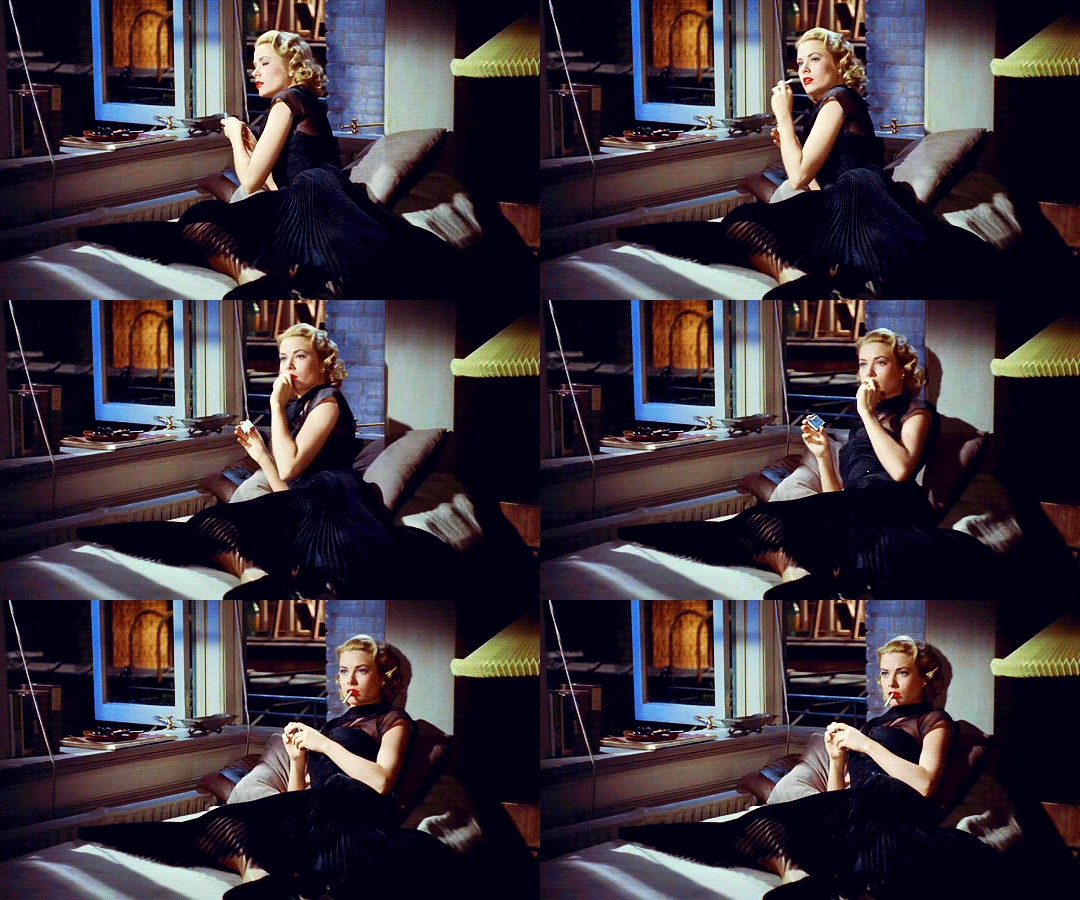
Rear Window (1954) — Alfred Hitchcock

Photo | REAR WINDOW (1954)

Alfred Hitchcock’s, Rear Window (1954) is a must see for two reasons:
Reason number one is that it portrays people watching at its finest.
Reason number two is that everything Grace Kelley wears is fabulous, like her.
Unnumbered reasons include, but are not limited to the clever wit and as with all of Hitchcock’s film, cinematographic superiority, perfectly designed sets and those over exaggerated, yet charming facial expression all over the face of Jimmy Stuart.

Currently Watching The Great Gatsby | F. Scott Fitzgerald

Fashion for the men?
Pearls.  Champagne.  Parties.  More champagne.  Jazz.  A little more champagne.  What does all this bring to mind?  The roaring twenties, of course. The era in which the popping of corks was the soundtrack to which existed the one side of the social ladder, while the clanking of industrial wheels was the rhythm to which danced the other.
Mia Farrow and Robert Redford bring Fitzgerald’s, The Great Gatsby to life with all of the necessary white roses, dazzling parties and endless bubbles.

If you were a diligent, young student during your high school years and actually read the great American classic, you will find Jack Clayton’s (1974)  film a charm, charm, charm.

Humility and Modesty

Every real thing is surrounded by many counterfeits.  That is what makes a simple concept difficult to understand and a simple object hard to classify.  Often things are labeled with misleading names so when one thinks he is comparing apples to apples, he is unaware that he is actually comparing apples to cucumbers.  When he finds no natural correlation between the two, he either creates a convoluted equivalence in order to draw some conclusion or dismisses the concept as a thing that is much too abstract for \understanding.
Some things are so rare that their faux counterparts become the new standard and as things are defined by the impostor, the real thing gets lost and forgotten.
Humility and modesty are two such rarities. They are so uncommon that on the rare occasion we come across them, we don’t know what to do with them because what we are accustomed to call that, is actually the counterfeit version, something else.
Both have collected such bad publicity over the years that they mean something frigid and lame, but in reality:
True Modesty is a discerning grace,
And only blushes in the proper place;
But counterfeit is blind, and sculks through fear,
Where ’tis a shame to be asham’d t’appear:
Humility the parent of the first,
The last by vanity poduc’d and nurs’d.
– William Cowper

Why You Should Visit the Vanderbilt Estate Library in Asheville, NC


Stepping into this room at the Vanderbilt Estate in Asheville, North Carolina reminded me of that glorious scene from Walt Disney’s, Beauty and the Beast. I must add, this just may be my favorite cartoon scene of all time. You know the part when the Beast orders Belle to close her eyes. He blindly leads her into a room. Tells her to open her eyes— magic. She is surrounded by endless bookshelves lining the walls overfilling with beautifully-spined books to her left and to her right; above and below, books, books, and more books.

That is how I felt inside of the Vanderbilt Estate library. It was large, the ceilings were high and not an inch of bare wall space remained.  Floor to ceiling, wall to wall, space was slathered with books.  Every topic that could be named in the early nineteen hundreds could be found in this collection. High and low, gorgeous, leather-bound books glistened with their meticulously ornamented spines.  Rooms filled with books create a magical atmosphere, they give the impression that you are not really breathing oxygen, but rather inhaling wisdom.

Overall, I highly recommend the tour of the Vanderbilt Estate if you ever find yourself in or around Asheville. The house is gorgeous, sitting on a beautiful plot of land where you will find gardens, an operating vineyard, restaurant, café, and a hotel. What else does a tourist need?