Caspar David Friedrich

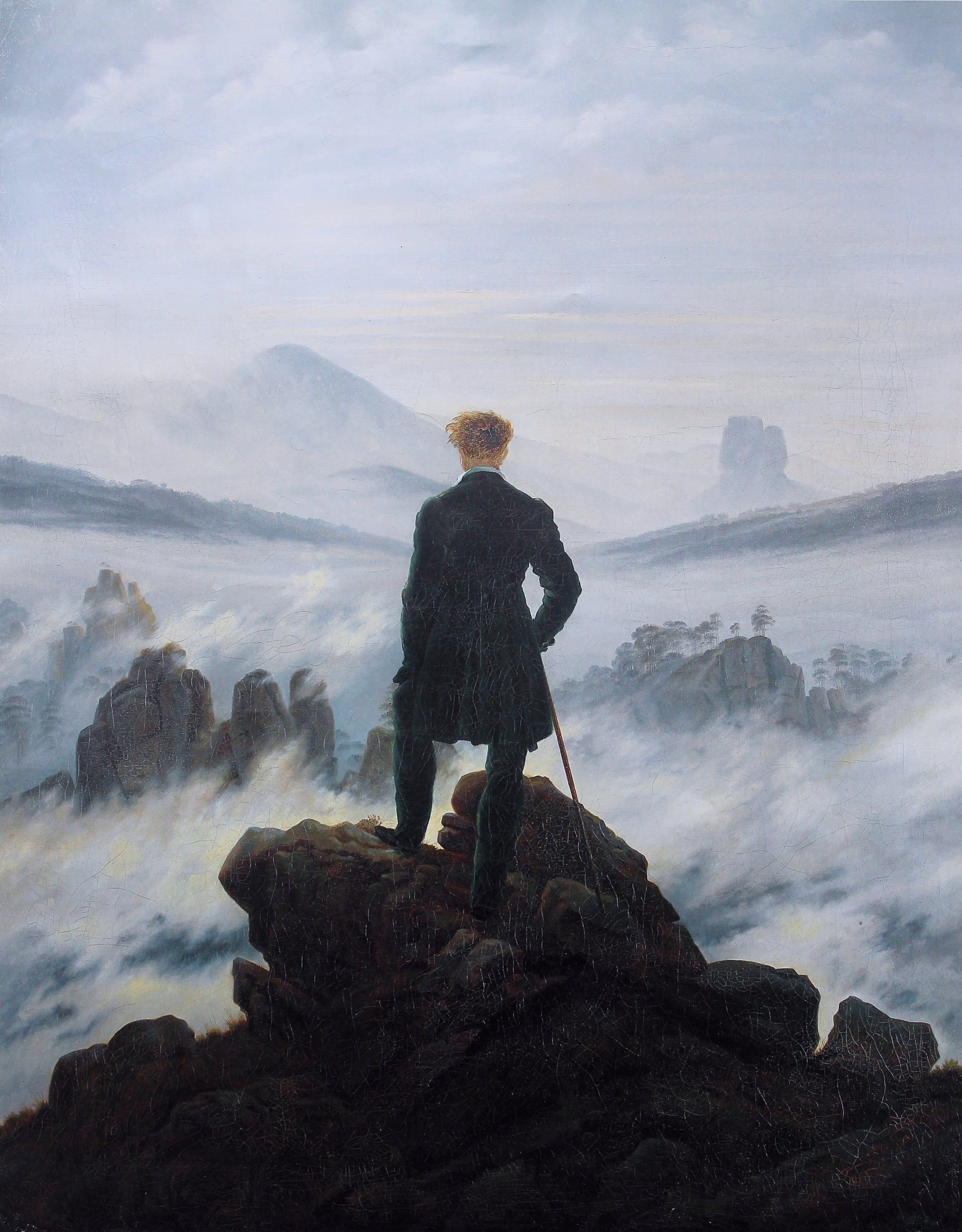
Caspar_David_Friedrich_-_Wanderer_above_the_sea_of_fog

Caspar David Friedrich said that “nature is too sublime for the multitude to grasp” and supported his idea by painting these wild, powerful landscapes that make nature entirely impossible to grasp.  Just looking at dingy pictures of his work usually sends chills down my spine, I cannot imagine what kind of effect the original paintings would produce.

He was a German, devout protestant, Romantic painter and this is his, Wanderer above the Sea of Fog 1818.

A Day with Solomon

René Reichelt

Photo | René Reichelt

Everyone gets dragged into that question game that asks silly questions and produces even sillier answers.  Questions like “if you could spend a day with anyone dead or alive, who would it be?”

So, who would it be?

I would call for the best.  The wisest, the most alluring personality in all of history.  He was a literary phenomenon authoring one of the greatest pieces of poetry ever recorded.  He was admired by everyone, including his enemies.  He was good with women as can be concluded when remembering that he had seven hundred wives and three hundred concubines.  He had exquisite taste as the depictions of his architectural endeavors prove.  He was wealthy beyond imagining.  He was powerful.  He was favored by God.  He had impeccable judgment and understood justice.

He would be Solomon.

The queen of Sheba (among countless other nobles and greats) went out of her way to meet him.  He must have been an intriguing man with a pleasant voice and many enchanting tales.  A day with him would be like honey to the mind.

Give Opera a Shot: La Boheme by Giacomo Puccini

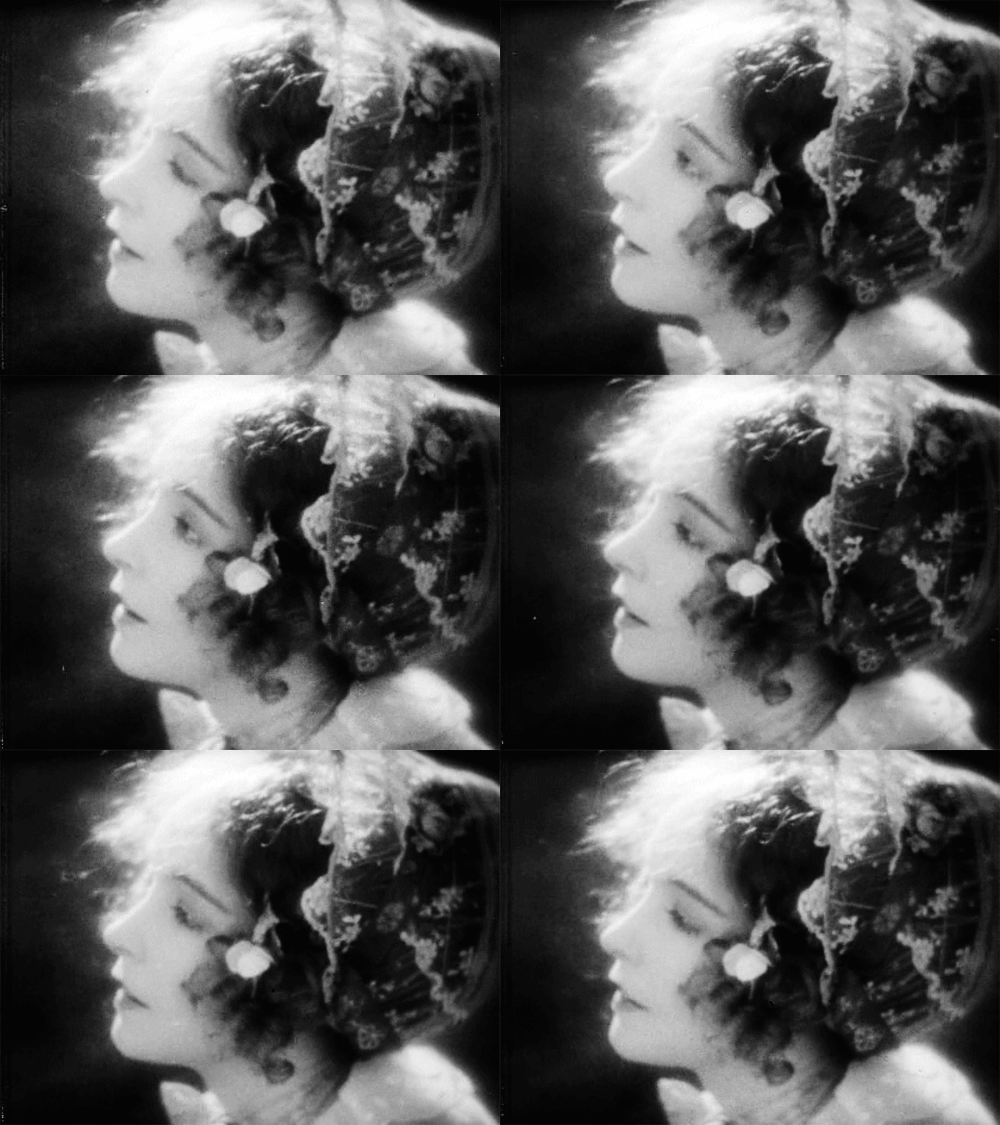
Lillian Gish in La Bohème, 1926

Based on my observations of the St. Pete Opera House, in about twenty years or so there will be no patrons left to patronize this art. There was barely a person below the age of 60 in the audience, but I think something like La Bohème could make it in the top of your charts if you give it a chance. Just prepare yourself.

By preparing yourself, I mean, read the opera story before you head out. People typically get bored because they don’t know what’s going on since most Opera gets sung in Italian, German, French, or Russian. Sometimes subtitles get projected on the wall, but then you’re missing the show. Just get familiar with the characters and the plot and the translation won’t be necessary, you will understand everything by following the emotions projected by the artists.

The Story of La Boheme by Giacomo Puccini

La Boheme by Giacomo Puccini is a witty and tragic Italian opera taking place on Christmas Eve around 1830, in the Latin Quarter of Paris.

.

Rudolpho, a poet, is looking out the window of a Parisian attic studio, while his painter friend, Marcello is working on his masterpiece, The Passage through the Red Sea. Both are penniless, trying their best to stay warm in their drafty apartment, as their empty fireplace “has had no legitimate payment” for a long time.
 .

Marcello stops painting to remark that the chilly waters of the Red Sea seem to be running down the back of his neck, just for that, he adds, “I will drown a Pharaoh.” He makes a few strokes with his brush and turns to Rudolpho. After a few witty comments and some philosophizing about love, the two realize that they are still freezing and starving. Suddenly, Marcello suggests feeding his Great Masterpiece to the furnace, but Rudolpho objects saying that it will stink up the place. Then Rudolpho grabs his bulky manuscript of the play he is writing and begins tearing pages for the furnace. The scene continues as their two friends, philosopher, Colline, and musician, Schaunard enter the studio.

.

The friends go out, and as to be expected from all things Italian, things start heating up. Mimi and Musetta come on the scene and with them a whole plethora of emotions. Tenderness, passion, jealousy and things get hotter and hotter to the death. Whose death? You will have to go find out for yourself.

Why You Should Give Opera Chance

I get it– Opera can’t compete with light shows and synthesizers. It’s a different animal requiring high-level talent and soul. It takes a real artist to fill a theater with their voice, and even when the words don’t make sense, or the style is not your top choice the experience is worth it. The emotional energy coming from an Opera stage will inspire, uplift, and take your emotions for a spin.

George Bernard Shaw on Choosing a Mate

my-fair-lady

Photo | My Fair Lady (1964)

When it comes to the mate-choosing phenomenon, George Bernard Shaw had some rather keen observations at the conclusion of, Pygmalion.  He worded them so eloquently, I will share them verbatim, but first about the play.

The film, My Fair Lady (1964) was based on the play by George Bernard Shaw who borrowed the plot from the myth of Pygmalion. The original story was written by Ovid, back in the day and goes something like this:

There lived a top notch sculptor, who sculpted a top notch sculpture. His skills were so top notch that his statue came out to be more than he bargained for. His medium was ivory and his matter was a woman.  His ivory woman was so perfectly sculpted under his skillful chisel that to his shame he fell madly in love with her. Despite the fact that she was ivory. But phew! Venus, the goddess of love came to his rescue. She felt pity for him and brought the love of his life to life.  The sculptor married his sculpture and they lived happily ever after— or so we will conclude for now.
.
Now back to Shaw’s observations. Since they did not fit into the play he just threw them into the epilog as a freebie:

“Women, like men, admire those that are stronger than themselves. But to admire a strong person and to live under that strong person’s thumb are two different things. The weak may not be admired and hero-worshiped, but they are by no means disliked or shunned, and they never seem to have the least difficulty in marrying people who are too good for them. They may fail in emergencies, but life is not one long emergency: it is mostly a string of situations for which no exceptional strength is needed, and with which even rather weak people can cope if they have a stronger partner to help them out.

Accordingly, it is a truth everywhere in evidence that strong people, masculine or feminine, not only do not marry stronger people but do not show any preference for them in selecting their friends. When a lion meets another with a louder roar “the first lion thinks the last a bore.” The man or woman, who feels strong enough for two, seeks for every other quality in a partner than strength.

The converse is also true. Weak people want to marry strong people who do not frighten them too much, and this often leads them to make the mistake we describe metaphorically as “biting off more than they can chew.” They want too much for too little; and when the bargain is unreasonable beyond all bearing, the union becomes impossible: it ends in the weaker party being either discarded or Bourne as a cross, which is worse. People, who are not only weak but silly or obtuse as well, are often in these difficulties.”

Here, here now… think about this before your next date.

Babette’s Feast (1987): The Best French Meal You Ever Saw


“Quite definitely, this is genuine turtle soup.  Slurp. It is truly the best Turtle Soup I’ve had in years.”  Slurp-slurp.  This Danish film will awaken your taste buds and leave you dreaming of genuine Turtle Soup and Clos de Vougeot 1845, for many sleepless weeks.  The film is a feast for all senses.

I once wrote a very long film analysis comparing the film, Babette’s Feast (1987) with the book by Isak Dinesen.  I had to re-watch it multiple times, I mean really watch it on VHS because that was the only version I could track down after hunting through every library in the county.  Despite the whizzing of video rewinding, I’d watch it again with anyone who doesn’t mind sitting through a very slow, deeply moving, work of art, with sub-titles.

“General Galliffet, who was our host for the evening, explained that this woman, this head chef had the ability to transform a dinner into a kind of love affair— a love affair that made no distinction between bodily appetite and spiritual appetite.” But you have to watch it understand.

GIFF’S | HERASYED